Posts

Video Messages from your Teachers

Hi grade 3/4! We all miss you so much, we created these short videos to say hi. We'd love to hear from you, send us an email soon if you can! Mrs. Clark's Video, Room 301: Ms. Hammadieh's Video, Room 302:  Ms. Sinclair's Video, Room 303: Ms. Jaques's Video, Room 304: Ms. Sarah's Video, Room 305:
Hi families! The Grade 3/4 classes are continuing to learn about the 4 countries in Social Studies (India, Peru, Ukraine, and Tunisia). Ms. Sarah's class is now learning about Peru. We began by looking at Peru on a world map and making predictions about the country's climate and geography based on it's physical location. We are now researching animals that live in Peru. There are thousands of animals and insects to have chosen from, as the Amazonian Rainforest covers some of Peru! Also, Ms. Sarah's class has begun a new novel study. We are now reading Matilda , by Roald Dahl. The students are loving it! Ask your child to share about the book using the following prompts: Describe Matilda. What is she like? What is Matilda's family like? Does Matilda fit in with her family? Why/why not? What is your favourite part in the book so far? In math, students have continued to practice and build upon their understanding of multiplication (up to 5x5 for grade 3 ...

Guide Dogs and Multiplication

Image
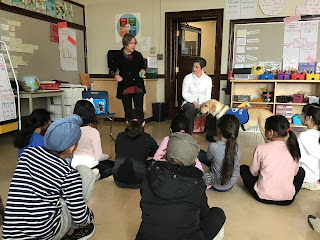
Last week most of the grade 3/4 classes had a visit from a guide dog in training! A puppy learning how to be a guide dog for blind people came to our classes, along with the volunteer training her. Students learned about the importance of volunteers in our community, about some of the important commands the dogs need to learn to help keep their person safe, and about ways our community can accommodate the needs of blind people. My favourite was watching Ria play tug of war, but then stop instantly at a single command! The dogs were so smart, and not even one year old! We are continuing our exploration of multiplication, with a focus on arrays. Students are learning how to represent multiplication visually. You can find out more about arrays  HERE  - try practicing at home! Set up arrays of canned food or shoes or other household items, and have your child practice figuring out how many there are using a strategy like skip counting, doubling, or repeated addition. It is im...

Pysanky Eggs

Image
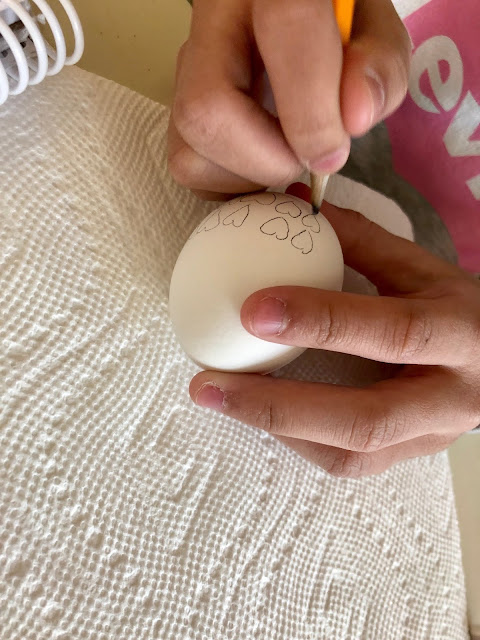
This past month in Social Studies, and for the next three months, each class has been focussed on exploring one country. Each class will delve into either Ukraine, Tunisia, India, or Peru for one month before moving onto the next. (Ask your child what country they studied in February and what unique things they learned about that culture.) Throughout February, Ms. Sinclair's class was researching Ukraine. We looked at landforms, animal life, agriculture, language, and many aspects of Ukrainian culture. To end the month we created Pysanky Eggs, which is a traditional art project involving decorating and dying eggs. Students each explained the process of Pysanky, looked at the significance of the traditional symbols, and designed their own egg.  Things then got messy and fun as we decorated, dyed, and blew out our eggs so that only the colourful shell remained!  Have a look at some of our beautiful creations! 
Stem Challenge

Image
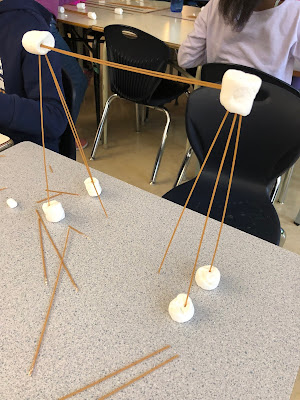
Spaghetti Tower Marshmallow Challenge In science students have been learning about the 4 main types of bridges, beam, arch, truss, and suspension bridges. We began with our own building spaghetti tower marshmallow challenge, this was a team building activity that encouraged students to use their design mindset and team work skills! Students were challenged with attempting to build the tallest possible tower that could support a marshmallow.  Each group was given  s paghetti, tape, string  and 18 minutes to complete the task!   Students please share what was difficult about this challenge? What shapes did you discover were the strongest? What might you do differently next time? In math students have been using a variety of strategies to aid in our understanding of multiplication. We have been learning the following strategies: array  equal groups repeated addition  number lines  Students please share how we use each s...

Growth Mindset in Learning

Image
Growth Mindset in Learning Everyday, in Grade 3/4, students take risks in their learning.  This is integral to growth mindset and building up resilience muscles.  Students have worked hard on self talk strategies such as,  "I can be brave and strong," and "It's okay to make mistakes because that is how I can learn."Through our building centers, literacy centers, math learning and entry into our study of Four Countries, students practice their self regulation, self - talk, citizenship and personal development.  

Bridge Challenge!

Image
Bridge Challenge! This week in Ms. Sarah's class, we have been building bridges! We began by learning about the 4 main types of bridges: beam, truss, arch, and suspension bridges. We then learned about strong shapes (triangles) and what materials bridges can be made out of. We also looked at some famous bridges from around the world! Using their understanding of bridges, students built bridges using popsicle sticks, toothpicks, and plasticine (some groups requested additional supplies). The bridge had to span a river with a width of 30cm! We learned that it is very difficult to build a bridge using spaghetti and marshmallows! In the future, we are hoping to build a bridge strong enough and wide enough to drive a school robot across! Here's a look at our bridges: Reflection: - What type of bridge did your group build? - What worked well for your group? - What didn't work well for your group? - What would your group do differently if presented with...

Lougheed House trip & Lady Belle

Image
This week Ms. Jaques' and Ms. Sinclair's classes went on a field trip to the Lougheed House on 13th Avenue. (Next week the rest of the 3/4s will get to go as well.) Before we went we did some research about Calgary's history, and James & Isabelle Lougheed's lives, at the amazing Canadian Virtual Museum website HERE . The Lougheed House was built in 1891. At that time, Calgary was very small, it didn't have very many buildings. The population was only 100! Lady Belle advertised for Calgary and tried to get more people to move here. At the time the Lougheed House was on the outskirts of Calgary and there were no buildings around it. Sir James and Lady Isabelle Lougheed are known for helping Calgary grow. James was knighted after World War 1 for helping Britain win the war. Lady Belle was Metis. Metis people are people of two cultures - European and Indigenous. Lady Belle's mother was Metis, and her father was English. She spent a lot of her life hi...

Famous Structures

Image
This week, in teams of two or three, students researched and presented on a famous structure. They explored the purpose behind building the structure, when it was built, where it can be found in the world, and many other facts about why it is unique. Teams then used resources from our Maker Cart to represent their structure and highlight its most unique features. Here are our creations:

January 20, 2020

Image
It may have been a chilly week in Calgary, but in Connaught, students were on fire with creativity! During our science time we got messy by building bridges using various materials... some worked better than others! Ask your child what materials they found to be the best. We tested many types of structures and discovered that the taller/skinnier a structure was, the less weight it could support. Our shortest and sturdiest buildings supported 3 glue-sticks while our tallest could only support 1. We also explored different types and categories of structures... can you name the three types of structures? (Support, Span, and Contain) Finally, we looked at some famous structures around the world. What structure is your child presenting on? In Social Studies we are preparing for our trip to the Lougheed House (if you would like to join us, email your child's teacher). We have explored who Lady Belle was and why the house is a significant landmark in Calgary. We have also be...

January 14th

Students have been learning about the six regions of Alberta in more detail. Students have been exploring various resources to document their knowledge in their visual journals of the following categories:  landforms bodies of water animals recreation vegetation  Students engaged in an activity titled "caption this" where they wrote a brief explanation of various photos. Students were tasked with creating juicy descriptions using quotation marks. Parents please ask your child when does a writer use quotation marks and why? Later we will be turning these captions into interesting paragraphs! Students please share which caption you wrote with your parents.  We have started gymnastics in physical education, students have engaged in various stations using the equipment such as balance beams and ladders to practice strength, flexibility and balance control.  We have been practicing our multi digit subtraction. We are learning, the sta...
Welcome back to a new year and a new decade!  We are so thrilled to welcome back all Connaught students!  Thinking ahead ten years, students shared what direction their lives will take at the end of the decade when they will be 18, 19 and 20.  It was exciting for them to imagine that they all will have graduated in 2030! This term promises to be engaging and enriching as we explore the curriculum with guest speakers, special projects and field trips.  Throughout January and early February, each of our classes will visit Lougheed House as part of a walking field trip to explore the life of Lady Belle.  Lady Belle was the first lady of Lougheed House, wife of James Lougheed, and entertained many royal and special guests at their manor and gardens here in the Beltline. Students will use artifacts to enhance their understanding of the life of this extraordinary change maker of Alberta. Watch for volunteer opportunities from your child's teacher. We are also en...
Alberta Regions https://www.raysweb.net/specialplaces/pages/grassland.html http://www.learnalberta.ca/content/sszi/en/index.html

December 10, 2019

Image
Happy December! Students in grade 3/4 have had a busy few weeks. We have DJD coming in every Wednesday to teach us different types of dance - last week we focused on swing dance and we learned moves like Shorty George and the Charleston. Ask your child their favourite dance move! Students in Ms. Jaques's class are continuing to work on building strategies to solve addition and subtraction problems. We are developing our flexibility with numbers. Some of the strategies we've come up with are Expanded Notation (breaking down each number and adding one place value at a time - 458+391 = 400+300+50+90+1+8), and Friendly Numbers (rounding to the nearest friendly number, then adjusting - 298+155 = 300+155-2). Practice these at home with your child! A great game you can play is the "license plate game" - find 2 license plates with 3 or 4-digit numbers and practice adding them together in your head. You can also do this with addresses or building numbers. We are beg...

November 26

Hi families, Grade 3/4 students are continuing to build their understanding of place value. This year, grade 3s are learning about numbers up to 1,000 and grade 4s are learning about numbers up to 10,000. When looking at large numbers, students are encouraged to think about the following questions: what value does this digit represent? How can I show this number? Can I show this number in many different ways? The grade 3/4 team has almost completed a full cycle of Power Hour modalities. This means that your student has almost completed all of the modalities and will have an opportunity to explore two modalities in more depth. They will combine 2 new modalities from Power Hour to complete a final project. Our class is continuing to read our novel, "Inkling" by Kenneth Oppel. In the novel, we learned what Inkling eats and how he eats! We also learned more about Ethan's mom, dad and sister. Can your student predict what will happen to Ethan's comic project?

Nov 19

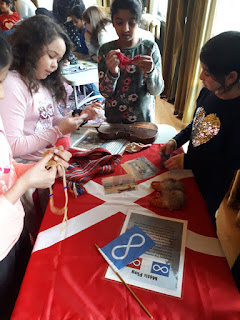
The grade 3/4 students have been learning about place value. We have been using the base ten number system to understand each digits proper place and its value. We have been learning how to represent our numbers in different ways such as standard form, expanded form, written and, using base ten blocks. This week grade 3/4 have been playing a variety of games to practice strategies we have learned to better help us understand numbers! We continued Power Hour, students please share which modality you learned this week and if you chose plant or animal life cycles to represent. We learned about Metis "the flower beadwork people." We studied a painting by Canadian artist named Christie Belcourt titled "My Heart is Beautiful." We used her beadwork art as inspiration to create our own! Began reading our class novel "The City of Ember" by Jeanne Duprau. Students began recording their knowledge and understanding of the stories setting, characters, thoughts an...

Power Hour

November 12th POWER HOUR has begun! The Grade 3/4 Team, along with Ms. Bezugley and Ms. Corinne, are engaged in a 7 modality project with all Grade 3/4 students. The modalities were chosen to engage students in unique ways to show their learning. The focus is to build student capacity in the modalities based upon representing their understanding of one of two units in Science we have all covered:  Plant Growth and Change and Animal Life Cycles. Teachers developed an individual rubric for their specific modality specifying what would constitute a 1, 2, 3 and 4 for that specific modality.  As a teaching team, we also created a rubric for the content portion of the project. Students are aware of these rubrics and how they would be assessed in each center. They are given as much flexibility in choosing whether they show their understanding of Animal Life Cycles or Plant Growth and Change.  For example, one grade 4 student chose a pumpkin as her plant for Visual Journali...

October 29

Image
Scientists in School! "Life's Like That" All grade 3/4s participated in Scientists in School last week. Scientist Amanda, a biologist, came and led us through some hands-on activities about classifying animals, describing their life cycles, and examining some creatures up close. How Many Seeds in a Pumpkin? Students were so excited to count pumpkin seeds this week! Students estimated and measured how many seeds each class pumpkin had as well as its weight, height, circumference and, number ribs! later we opened up our pumpkins and each table group counted their seeds to see how many pumpkin seeds we had all together! Here are some questions students were asked to think about: What estimation was closest? What estimation was furthest ? What else could we estimate and measure ?

October 22

Image
Skip Counting Students in Ms. Jaques's class have been practicing skip counting by 2s, 3s, 5s, and 10s. We are working on starting at different numbers, not multiples (for example, count by 5s starting at 26). We are also using skip counting circles to see the patterns and similarities in skip counting. Look at our beautiful patterns! Game Redesign Students in Mrs. Clark's class participated in Game Redesign of a patterning question involving animals and food they would be collecting.  Examples were Bunnies and Carrots and Fish in the Coral.  They shared their redesign and open ended games with their peers for Grade 3/4 Game Day. Community Walk We have continued to explore the meaning of home to us by venturing out into the neighborhood with our Walking Field Trip to Lougheed House. We used both photography, sketching and journalling to share our perspectives on "where we can find home in our community."

October 15

We have been learning about waste in our world, using drama and literature. We have been practicing and creating presentations to teach the school more about recycling and where our waste goes! Parents please ask your child about the following questions: What are the 4 R's? What are some ways that we can reduce the amount of waste we create in our school and home? How can we reduce the amount of soup spoons we use at school?  These cannot be recycled and go directly to the landfill? What effect will REUSING and REFUSING have on the amount of waste in our world.  We are also collecting soup spoons this week to have a baseline of how many plastic spoons are used per week. Our goal is to show this information visually to the school and work towards awareness of ways to reduce this. Thank you for your support in sending in a metal spoon that will come back home on soup days if your child eats soup.  In science we have been preparing for our Tomatosphere project (grow...